

Article: How to Build a CrossFit Home Gym: The Complete 2026 Guide
How to Build a CrossFit Home Gym: The Complete 2026 Guide
How to Build a CrossFit Home Gym: The Complete 2026 Guide
Building a CrossFit-style home gym is one of the best investments you can make in your training. No commute, no waiting for equipment, no membership fees — just you, your gear, and the work. But the gap between a pile of random equipment and a setup that actually lets you train every movement well comes down to what you buy and in what order.
This guide walks you through exactly how to build a complete CrossFit home gym in Canada — what each piece does, how much weight and space you need, and how to do it without overspending. By the end you'll know precisely what belongs in your gym and what it should cost.
Who this guide is for
Whether you're converting a corner of the garage, kitting out a basement, or building a serious daily training space, the fundamentals are the same. CrossFit blends weightlifting, gymnastics, and conditioning, so a good home setup needs to cover three jobs: lift heavy, move explosively, and condition hard. Everything below maps back to those three.
Step 1: Plan your space before you buy anything
The most common mistake is buying gear before measuring the room. A few minutes here saves you returns and frustration later.
- Footprint: A functional setup fits in roughly 8 x 8 feet (about 6 square metres). A rack, bench, and weights need surprisingly little floor — it's the movement around them that needs clearance.
- Ceiling height: You need enough headroom to press a barbell overhead while standing on a platform. Eight feet is tight; nine or more is comfortable. If you're in a basement, measure before you commit to a tall rack.
- Flooring: Concrete will destroy your plates and your joints. Lay down rubber tiles to protect the floor, deaden noise, and give you a stable surface for lifts and jumps. A rubber flooring tile system is the simplest way to do this and you can expand it as your gym grows.
Step 2: The foundation — a rack
Your rack is the single most important purchase. It's what lets you squat, press, and pull safely without a spotter. There are three common options:
- Squat stands — the smallest footprint and lowest cost, ideal if space is very tight, but the least stable for heavy work.
- Folding wall-mounted racks — the best balance for most home gyms. A folding wall-mounted rack bolts to the wall and folds flat when you're done, reclaiming your floor for conditioning and gymnastics work. For garages and shared spaces, this is usually the right answer.
- Full power racks — the most stable and feature-rich, but they take up permanent floor space.
For most people building their first serious setup, a folding rack hits the sweet spot of stability, safety, and space efficiency.
Step 3: A bench you can actually use
A solid adjustable bench unlocks pressing variations, rows, step-ups, and accessory work. Look for a heavy-duty frame that adjusts from flat to incline and won't wobble under load. A heavy-duty adjustable incline bench is a long-term piece you'll use almost every session — don't cheap out here, because a flimsy bench is both unpleasant and unsafe.
Step 4: Barbell and bumper plates
This is your strength engine. You'll want an Olympic barbell and a set of bumper plates — rubber-coated plates that can be dropped safely, which matters for cleans, snatches, and any lift you might need to bail from.
How much weight should you start with? A practical starter set for most lifters is around 230–260 lb total, which covers the majority of training loads while you build strength:
- 2 x 45 lb
- 2 x 35 lb
- 2 x 25 lb
- 2 x 15 lb
That spread lets you load everything from an empty-ish bar for technique work up to a respectable working weight, and add micro-jumps as you progress. Olympic bumper plates are sold individually so you can build the exact set you need. You can always add heavier plates as your numbers climb.
Step 5: Conditioning and gymnastics tools
Strength is only one third of CrossFit. These pieces cover the explosive and metabolic work:
- Kettlebells — swings, cleans, snatches, goblet squats, and loaded carries. For a versatile home setup, three bells covering a light, medium, and heavy load go a long way. A common men's progression is 16 kg, 20 kg, and 24 kg; many women start lighter. Cast iron kettlebells are colour-coded by weight so you can grab the right one mid-workout.
- Wall ball — wall-ball shots, cleans, and slams in one tool. A 20 lb wall ball is the standard men's CrossFit weight; 14 lb is the common women's standard.
- Plyo box — box jumps, step-ups, and dips. A large 3-in-1 plyo box gives you multiple heights in one piece.
Step 6: Accessories that punch above their weight
- Resistance bands — assistance for pull-ups, mobility and warm-ups, and accessory work. A set of bands in graduated tensions (light to heavy) covers everyone in the household.
- A jump rope — the cheapest, highest-return conditioning tool there is.
What a complete CrossFit home gym costs
Built piece by piece, a complete setup — rack, bench, plates, kettlebells, plyo box, wall ball, and bands — typically runs north of $2,000 CAD depending on the brands and weights you choose. The real cost, though, is the time spent researching each item and the shipping you pay multiple times over.
The shortcut: a complete package
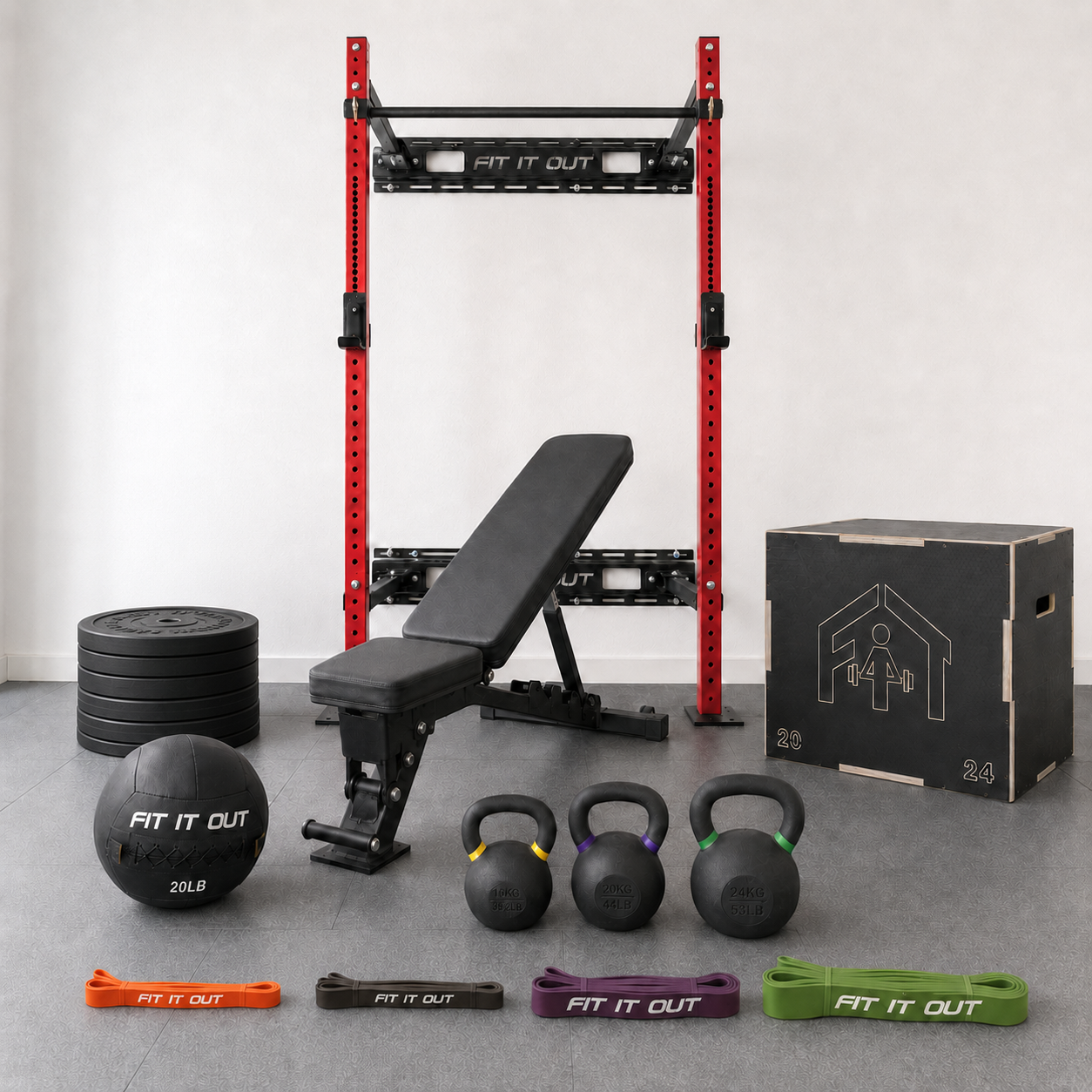
If you'd rather skip the piece-by-piece research and get everything that works together out of the box, our Complete CrossFit Home Gym Package bundles all of it:
- Wall-mounted folding power rack (90")
- Heavy-duty adjustable incline bench
- Olympic bumper plates — 240 lb total
- Large plyometric box
- 20 lb wall ball
- Resistance band set
- Cast iron kettlebells — 16, 20 & 24 kg
It's over $2,150 of equipment for $1,799 — a saving of more than $350 versus buying the pieces separately, and it ships Canada-wide with a 1-year warranty and hassle-free returns.
Shop the Complete CrossFit Home Gym Package →
Frequently asked questions
How much space do I need for a CrossFit home gym? A functional setup fits in about 8 x 8 feet, with enough ceiling height to press a barbell overhead. A folding rack is the best way to keep your floor clear for conditioning and gymnastics work.
How much does it cost to build a CrossFit home gym? A complete setup usually runs over $2,000 CAD bought piece by piece. A bundled package brings that down — our complete package is $1,799, over $350 less than the items separately.
What's the minimum equipment to start? A rack, a barbell with bumper plates, and one or two kettlebells will let you train the vast majority of CrossFit movements. You can add a bench, plyo box, and wall ball as you go.
How much weight do I need to start? A starter plate set of roughly 230–260 lb (pairs of 15, 25, 35, and 45 lb) covers most training loads. Add heavier plates as your lifts progress.
Do I need special flooring? Yes — rubber tiles protect your floor and equipment, reduce noise, and give you a safe surface for lifts and jumps. It's a small cost that prevents expensive damage.
Ready to build your space? Start with the Complete CrossFit Home Gym Package — everything you need in one order, shipped across Canada.

